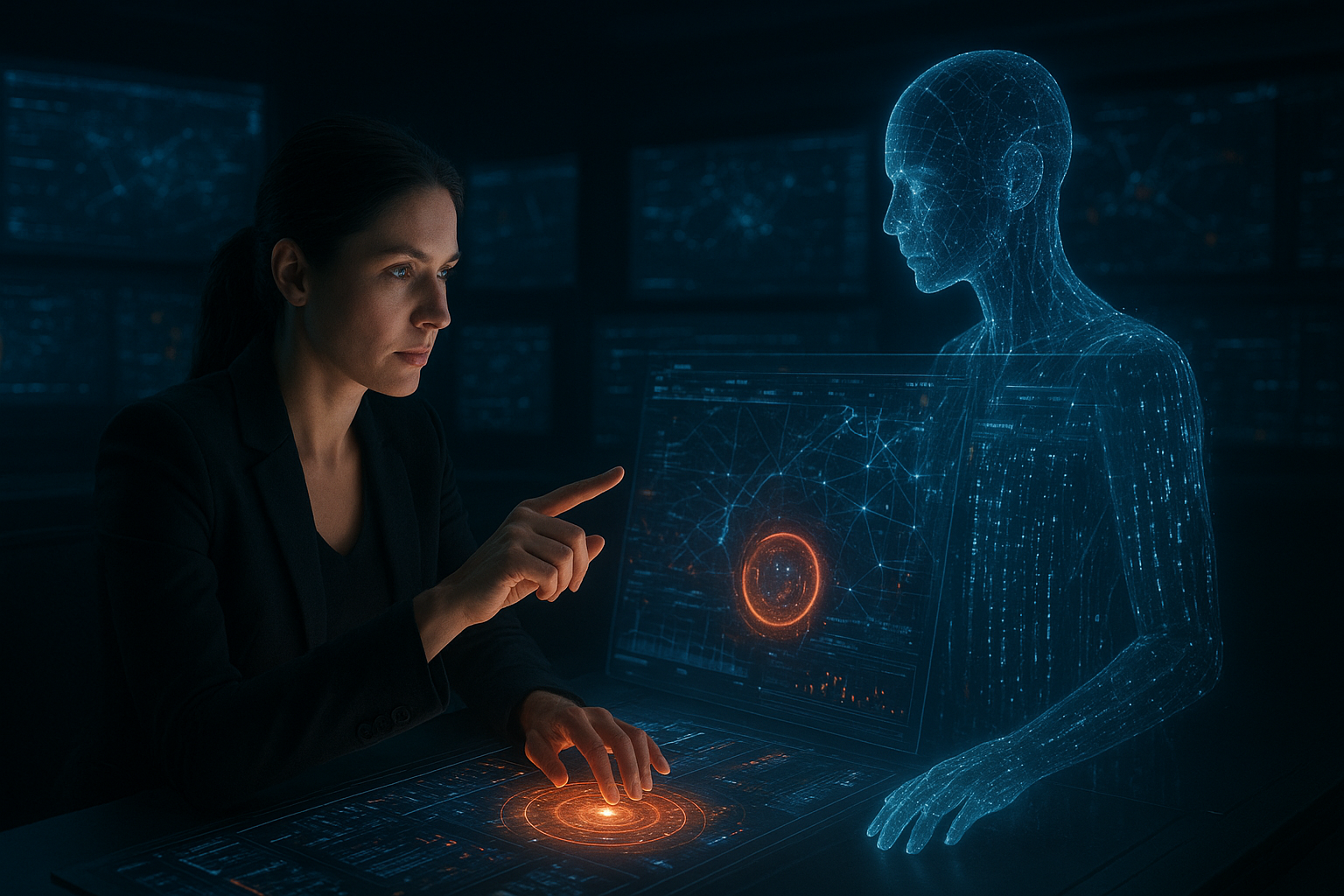
Imagine a high-stakes game of chess, but you’re playing against a thousand opponents at once. Your pieces are your network endpoints, your king is your company’s crown jewel data. For years, human cybersecurity analysts have been the grandmasters in this relentless game, relying on pattern recognition, experience, and a healthy dose of intuition.
Now, a new player has joined their side: an AI that can see every move on every board simultaneously, predicting threats a dozen steps ahead. It’s powerful, it’s fast, and it never sleeps. But as we integrate this powerful AI threat detection into our security stacks, a critical question emerges: Is this incredible tool secretly dulling the very skills that make human analysts indispensable?
The answer isn’t a simple yes or no. It’s a complex dance between silicon and synapse, and the future of security depends on getting the steps right.
The Rise of the Machines: What AI Threat Detection Brings to the Table

Red Strand in Data Flow
Let’s be clear—AI and machine learning (ML) have revolutionized cybersecurity. They’ve addressed fundamental human limitations in a digitally exploding world.
- Scale and Speed: A human can’t sift through terabytes of logs in milliseconds. AI can. It analyzes network traffic, user behavior, and endpoint activities at a scale utterly impossible for any human team, identifying anomalies and known malicious signatures instantly. According to an IBM report, companies using fully deployed AI threat detection and automation experienced a 108-day shorter time to identify and contain a breach—a massive difference in damage control.
- 24/7 Vigilance: Threats don’t clock out at 5 PM. AI systems provide constant, unwavering surveillance, eliminating the gaps that attackers love to exploit.
- Reducing Alert Fatigue: This is the big one. Security Operations Centers (SOCs) are often drowning in thousands of alerts daily, the vast majority of which are false positives. AI-powered systems, like those leveraging User and Entity Behavior Analytics (UEBA), excel at correlating weak signals and filtering out the noise, presenting human analysts with a much shorter list of high-fidelity, genuine threats.
In essence, AI has become the ultimate force multiplier. It handles the tedious, high-volume tasks, allowing human analysts to breathe. But herein lies the potential pitfall.
The Double-Edged Sword: AI threat detection Where Over-Reliance Can Dull the Edge
When we automate a process, the skills required to perform it manually can atrophy. It’s a classic principle, and cybersecurity is not immune. The risk isn’t that AI will suddenly become sentient and replace everyone; the more insidious risk is that human analysts might slowly lose their edge by becoming passive consumers of AI’s output.
- The “Black Box” Problem: Many advanced ML models are complex. An analyst gets an alert: “AI Confidence: 98% – Likely Malware.” But why? What were the 17 micro-behaviors that led to this conclusion? If the analyst simply trusts the box and moves on, they miss a crucial learning opportunity. They fail to develop the investigative instinct that comes from manually connecting the dots. As a cybersecurity veteran once told me, “Your intuition is just your subconscious recognizing patterns you’ve seen before.” If AI does all the pattern recognition, how does intuition develop?
- The Erosion of Fundamental Skills: Will new analysts ever learn the deep, painstaking art of manual malware analysis or log parsing if an AI summary is always a click away? It’s like relying solely on a GPS; you might arrive at your destination, but you never truly learn the city’s layout. A study from MIT’s Computer Science and Artificial Intelligence Laboratory (CSAIL) highlights that the most effective security strategies involve human-AI collaboration, not replacement, precisely because of unique human contextual skills.
- Complacency and Bias Amplification: AI is only as good as the data it’s trained on. If that data contains biases (e.g., focusing only on certain types of attacks), the AI will perpetuate them. A human analyst who defers to the AI without question might miss a novel attack vector—a zero-day exploit or a sophisticated social engineering campaign—that doesn’t fit the model’s historical understanding. The AI says “all clear,” so the analyst stands down, but a real threat is slipping through the blind spot.
AI vs. Human Analyst: A Comparative Look
| Capability | AI Threat Detection | Human Analyst |
|---|---|---|
| Processing Speed & Scale | Superhuman. Terabytes in seconds. | Limited by biology. |
| 24/7 Operation | Flawless and constant. | Requires shifts, rest, and is prone to fatigue. |
| Pattern Recognition | Excellent at known, defined patterns. | Excellent at spotting novel, ambiguous anomalies. |
| Contextual Understanding | Low. Lacks organizational nuance. | High. Understands business impact and nuance. |
| Creativity & Adaptability | Low. Operates within trained parameters. | High. Can creatively reason and adapt tactics on the fly. |
| Intuition & Gut Feeling | None. | A powerful, experience-based asset. |
The Symbiotic Solution: Augmentation, Not Automation
The goal isn’t to choose between AI and human intelligence. The goal is to fuse them. The most advanced SOCs are moving towards a model of AI-driven augmentation, where the machine handles what it does best, and the human is empowered to do what they do best.
This means building systems that don’t just provide an answer, but provide the reasoning.
- Explainable AI (XAI): The next frontier is AI that can explain its findings in human-understandable terms. Instead of “98% confidence,” the alert would read: “98% confidence. Reasons: Process X spawned from a temporary directory, attempted to call out to a known malicious IP range flagged by CISA, and exhibited code obfuscation techniques common in Ryuk ransomware.” Now, the analyst isn’t just a button-pusher; they’re a investigator with a powerful lead.
- Upskilling for the Human Firewall: The role of the analyst is evolving from a alert-triager to a threat hunter, incident responder, and AI-supervisor. They need to be trained to ask the right questions of the AI, to interpret its findings critically, and to use the time AI saves them to pursue proactive security measures. They become the strategists, while AI handles the tactical reconnaissance.
https://www.example.com/images/ai-human-loop.png
The ideal future: a continuous feedback loop where AI and human intelligence amplify each other.
Conclusion: The Edge is Evolving, Not Eroding
So, can AI threat detection erode the human analyst’s edge? Absolutely—if we let it. If we treat AI as a replacement and allow our skills to atrophy through disuse.
But if we embrace it as the most powerful tool ever added to our security toolkit, the human edge doesn’t erode; it evolves. The analyst’s value shifts from processing power to wisdom, from identifying the what to understanding the why and the so what.
The AI can find the needle in the haystack. But it takes a human to understand why the needle is there, who put it there, what they plan to do with it, and how to protect the entire farm moving forward. The future of security isn’t a choice between human and machine. It’s a partnership where one’s strength perfectly compensates for the other’s weakness, creating a defense that is truly greater than the sum of its parts.
