
Picture this: You’re in a meeting, and a colleague effortlessly generates a complex data analysis report, a targeted marketing campaign, and a first-draft project plan—all in the time it used to take to set the meeting agenda. This isn’t a scene from a sci-fi movie; it’s the reality for businesses that are leaning into the current wave of Artificial Intelligence.
Thank you for reading this post, don't forget to subscribe!We’ve moved past the phase of wondering if AI will change everything. The question now is, how will you harness it to not just survive, but aggressively grow? The landscape in 2025 isn’t about having a single AI tool; it’s about orchestrating a symphony of intelligent systems that work autonomously and strategically.
This post will cut through the noise and guide you through the most impactful Artificial Intelligence trends for 2025, providing a clear roadmap for integrating them into your business growth strategy.
From Hype to Hard Results: The Shifting AI Mindset
The initial frenzy around generative AI has settled into a more determined, results-driven pursuit. According to a recent McKinsey report, companies that are seeing the highest returns from AI are no longer just experimenting—they are weaving it into the very fabric of their operations.
The conversation has shifted from “What can this AI do?” to “How can this AI accomplish my specific business goals?” This strategic pivot is what will separate the market leaders from the laggards in the coming year.
2025’s Defining Artificial Intelligence Trends: A Strategic Deep Dive
Let’s break down the key trends that will define the business use of Artificial Intelligence in 2025.
1. The Rise of Agentic AI: Your New Digital Workforce
Forget chatbots that just answer questions. The next frontier is Agentic AI—systems that can perceive their environment, make independent decisions, and execute multi-step tasks to achieve a defined goal.

- What it is: Imagine an AI that you can instruct to, “Onboard the new hire in the marketing department.” It would then autonomously: create IT tickets, schedule training, populate the HR system, assign a mentor, and order equipment—all without a single human nudge.
- Business Impact: This is about massive efficiency gains. A study by the Harvard Business Review highlights how autonomous agents are revolutionizing functions from customer service to software development, freeing human talent for higher-level strategy and creativity.
- How to Leverage It: Start by identifying repetitive, multi-step processes in your operations (e.g., client provisioning, compliance reporting). Pilot an agentic AI platform on a single process to measure time and cost savings before scaling.
2. The Quest for Truth: Tackling Hallucinations and Ensuring Reliability
One of the biggest hurdles to widespread enterprise adoption has been the tendency of large language models (LLMs) to “hallucinate” or invent facts. In 2025, the focus will intensify on making AI outputs deterministic and trustworthy.
- What it is: This involves a multi-pronged approach: Retrieval-Augmented Generation (RAG), which grounds AI responses in your specific, proprietary data, and model fine-tuning, which customizes a base model for your unique domain and language.
- Business Impact: Reliable AI is safe AI. It means your customer service bot won’t invent a refund policy, and your internal research tool will cite verified sources. This builds trust and enables deployment in sensitive areas like legal, finance, and healthcare.
- How to Leverage It: Invest in AI systems that offer RAG capabilities out-of-the-box. Prioritize vendors who are transparent about their model’s training data and provide robust guardrails. Before deployment, establish a rigorous testing protocol for accuracy.
3. The AI-Native Organization: Baking Intelligence into Your Products
The most profound growth will come from companies that don’t just use AI, but are AI-Native. This means Artificial Intelligence is the core engine of their product or service, creating entirely new value propositions.
- What it is: Think of a project management tool that doesn’t just track tasks but uses AI to predict bottlenecks, automatically re-allocate resources, and draft status reports. Or a fitness app that generates a personalized workout and meal plan dynamically based on your daily recovery data and goals.
- Business Impact: AI-native products create insurmountable competitive moats. They offer a deeply personalized, adaptive, and “smart” experience that competitors without an AI core cannot easily replicate.
- How to Leverage It: Ask yourself: “If we had access to a perfect, omniscient assistant, how would we redesign our core product from the ground up?” Use this thought experiment to brainstorm transformative features, not just incremental improvements.
4. Shadow AI: From IT Threat to Strategic Opportunity
“Shadow IT” (employees using unauthorized software) has a new, more powerful cousin: Shadow AI. This is the unsanctioned use of consumer-grade AI tools by employees to do their jobs faster.
- What it is: A sales rep using a free chatbot to craft emails, or a developer using an AI code assistant not yet approved by the security team.
- Business Impact: While it drives individual productivity, Shadow AI poses significant data security, compliance, and brand consistency risks. Sensitive company data can be leaked, and outputs may not align with brand voice or legal standards.
- How to Leverage It: Don’t just ban it—channel it. Provide secure, company-approved AI tools that are better and easier than the consumer alternatives. Foster a culture of AI literacy and establish clear, sensible guidelines for responsible use.
Choosing Your AI Path: A Strategic Comparison
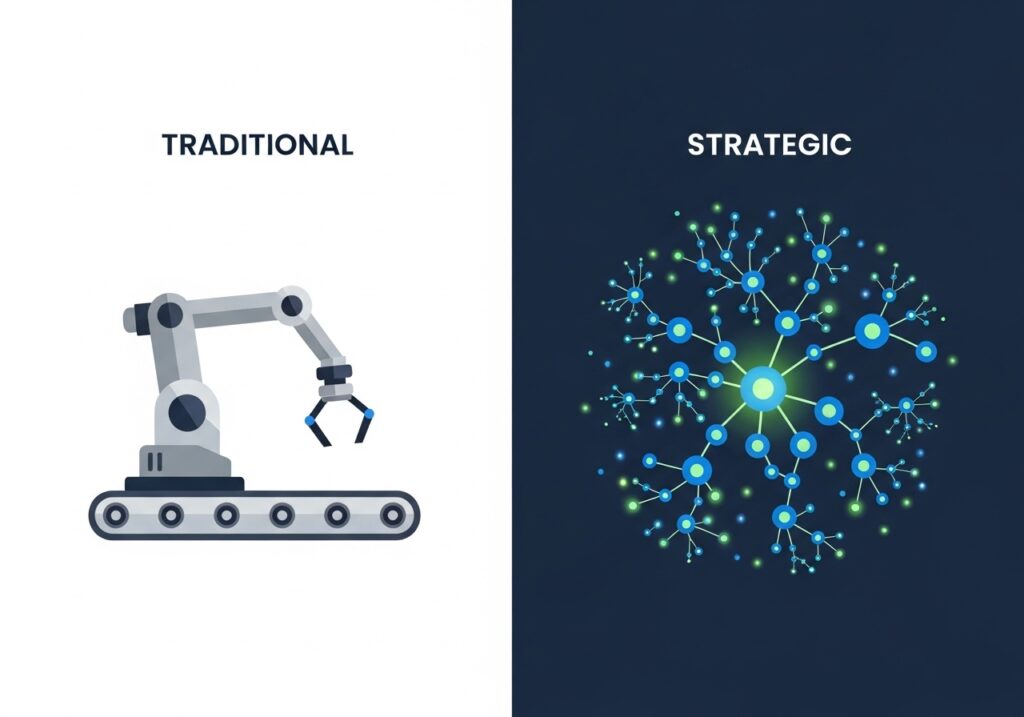
To help you visualize the strategic shift, here’s a comparison of the old versus the new AI approach:
| Feature | Traditional AI (The Past) | Strategic AI (2025 & Beyond) |
|---|---|---|
| Primary Goal | Automation & Efficiency | Autonomous Growth & Innovation |
| Key Technology | Single-task Bots & Classifiers | Agentic AI, Multimodal Models |
| Data Approach | Siloed, Structured Data | Unified, Knowledge-Graph Driven |
| User Interaction | Reactive (Responds to commands) | Proactive (Suggests actions) |
| Business Impact | Cost Center (ROI on labor savings) | Revenue Center (New products/markets) |
Your Action Plan for 2025
Feeling overwhelmed? Don’t be. Start with these three steps:
- Audit and Educate: Take stock of how AI is already being used in your organization (officially and unofficially). Launch training programs to upskill your team.
- Identify a High-Impact, Low-Risk Pilot: Choose one process from the trends above—like automating a multi-step operational task with an AI agent or implementing a RAG system for your sales team. Run a tightly-scoped pilot.
- Build an AI Ethics & Security Framework: In parallel with your pilot, develop company-wide policies on data privacy, model bias, and acceptable use. This isn’t a roadblock; it’s the foundation for scalable, safe growth.
The Future is Agentic
The Artificial Intelligence revolution is accelerating. The trends of 2025 point toward a more autonomous, reliable, and integrated future. This isn’t about replacing your team; it’s about augmenting them with a powerful digital workforce that can execute, analyze, and innovate at a scale previously unimaginable.
The businesses that will thrive are those that see AI not as a shiny toy, but as the new operating system for growth.

What’s Your AI Priority for 2025?
We’re all navigating this new landscape together. I’d love to hear from you: Which of these Artificial Intelligence trends are you most excited to explore in your business? What’s your biggest challenge? Share your thoughts in the comments below—let’s learn from each other.
